Packy AI
Sole mobile engineer — independent build, owned the entire client from architecture to release.
Combining AI-generated travel recommendations with deterministic user controls - keeping suggestions explainable and latency low even when model confidence varied.
01 —
The Problem
Combining AI-generated travel recommendations with deterministic user controls - keeping suggestions explainable and latency low even when model confidence varied.
02 —
Approach & Architecture
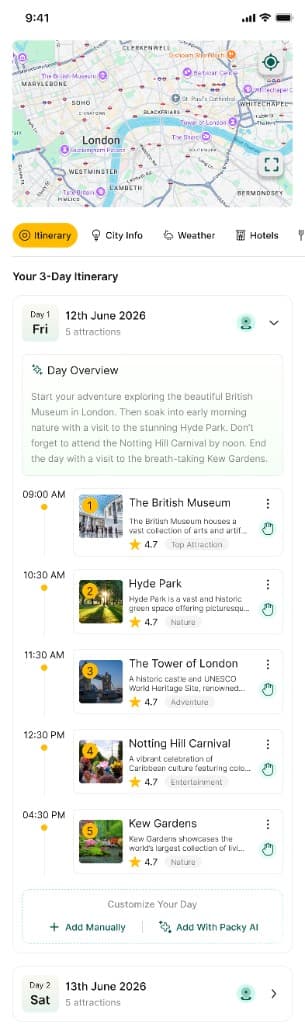
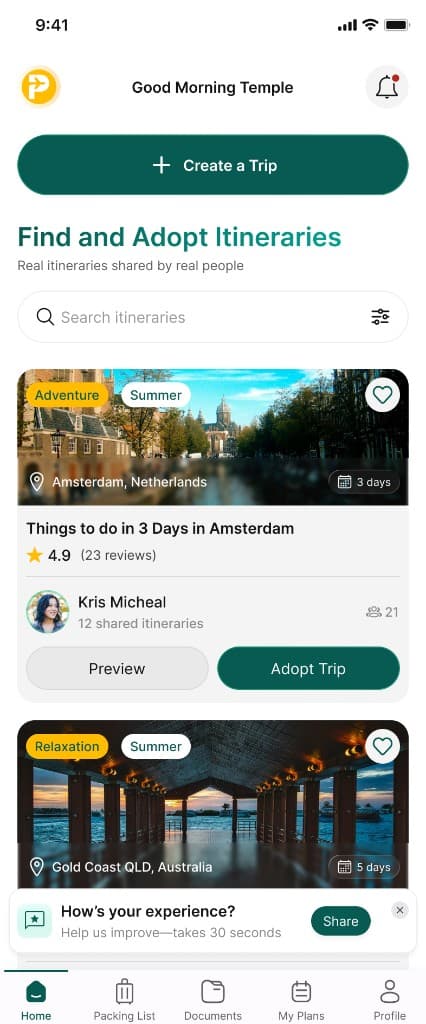
Delivered a planning workflow that generates practical travel itineraries using preferences, trip context, and user constraints. The implementation balanced AI-generated suggestions with deterministic interaction patterns to keep results explainable and reliable. The product focused on maintaining low-latency responses and preserving usability even when recommendation confidence varied.
Fast iteration mattered specifically here — the recommendation UI went through many rounds of tuning against real model output, and reshaping the client quickly without a native release cycle for every experiment kept that iteration fast.
Key decisions
- Combined deterministic client orchestration with AI-backed recommendation services.
- Normalized AI responses into stable internal view models for predictable rendering.
- Added fallback and re-ranking paths when generated output did not meet quality thresholds.
Security considerations
- Applied input sanitization and prompt guardrails for model interaction boundaries.
- Constrained profile data usage and removed non-essential payload fields in recommendation requests.
- Optimized response latency with progressive rendering and cached itinerary fragments.
03 —
Technical Challenges
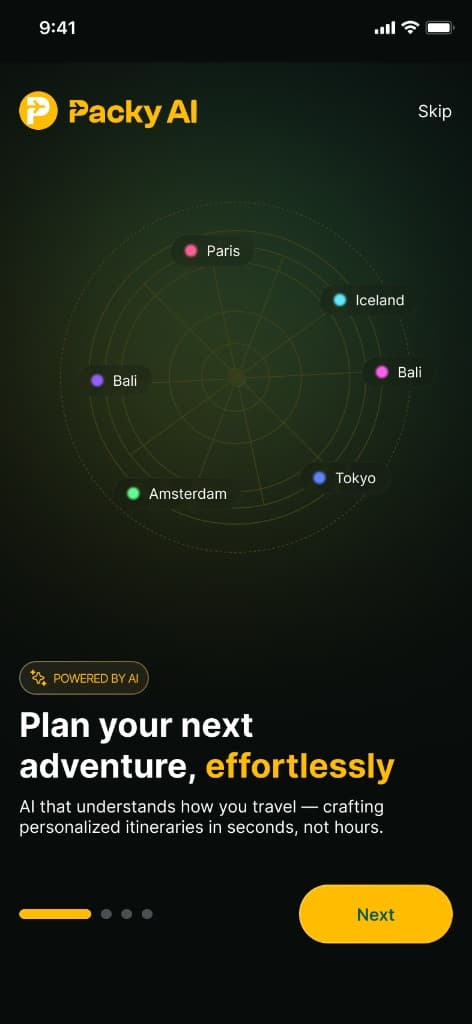
Integrating AI into a mobile experience isn't just an API call — it's a latency problem. The real challenge wasn't calling the model; it was designing an experience where the user always understood what the app was doing while it waited on a response.
04 —
Trade-offs
I deliberately kept some AI-driven features simpler than they could have been in the first version — instead of making every interaction fully dynamic, I focused on predictable, reliable results with clear loading and fallback states.
05 —
Outcome
Live on App Store and Play Store. Delivers personalized travel itineraries with fallback reliability across varying model output quality.
06 —
Lessons Learned
AI should improve the experience, not dominate it. Users care far more about responsiveness, clarity, and reliability than whether a feature is powered by the most advanced model available.
More Screens